Showing posts with label LGBTQ. Show all posts

Wednesday, August 28, 2013

Keith Hennessy: performing resistance, embodying reconstruction

Keith Hennessy: performing resistance, embodying reconstruction

by M. Soledad Sklate

Keith Hennessy

Keith Hennessy, the Canadian-born, San Francisco-based performance artist, dancer, choreographer, singer, juggler, teacher, queer dance pioneer, sex healer, ritual conductor, anarchist and activist knows what he performs for: to denounce “shit that seems wrong, fucked-up, oppressive, unjust, unnecessary, cruel, stupid, and expensive.” He also knows what stimulates his creative process. "Power, especially the asymmetrical power with its embedded violent hierarchies, is a kind of muse for me,” Hennessy says.

His activist performance style has resulted in praise for “breaking boundaries considerably more restraining than handcuffs, straightjackets or coffins,” (Movement Research Performance Journal #35, 2009) but also in multiple arrests. He estimates nine.

In spite of the distance that a virtual conversation imposes between us, Hennessy’s enthusiasm when talking about these experiences reveals that he takes pride in having been behind bars a few times. He considers them, in fact, important educational incursions into “the ugliness of power.”

Keith Hennessy
(photo courtesy of the artist)

Hennessy strongly rejects my attempts to dig for psychological explanations for his activism in his childhood or upbringing. This does not stop him, however, from extensively talking about his family background and how life was in the Canadian mining town of Sudbury (Ontario), where he was raised as one of five siblings of an Irish Catholic family.

His parents certainly did not encourage him to defy the forces of law and order. But he admits that “there was a really strong sense of justice that was handed to us by our family and some of that is connected to a kind of Catholic or Jesuit social justice. Be good to others. Don’t speak badly about others. Help others in the time of need.” While he was the only sibling who became an activist, he points out that one of his sisters embraced activist causes such as the feminist struggles of the 1970s and Quebec’s nationalist movement.

McGill University (Montreal), where he enrolled as a business student was, in the late 1970s and early ’80s, an ebullient place where ideas of social justice and activism were not only talked about but acted upon. Tuition increases, nationalist and labor politics, anti-apartheid initiatives and anti-nuclear movements mobilized the student body to protest, organize non-violent actions and political meetings, and to even shut down the school and the city center once.

Hennessy has an explanation for his unexpected choice of a traditional career. “Where I come from, there was no real imagination of what university was for, except to go to university in order to get a job. I didn’t have any other thoughts besides, ‘Am I doing pre-law?’ ‘Am I doing pre-med?’ or ‘Am I going into engineering?’ I thought I would be a lawyer and I would go to business school before that, so that was the trajectory.”

In spite of having an uncle who was an artist (but had a "real" job as well) and a mother who painted and collected art as a hobby, being an artist “was not an imagination that I could have,” Hennessy says. As for becoming a dancer or performer, “I didn’t even know that existed,” he adds.

At McGill, however, he complemented his business courses with dance classes and street performing. The jugglers, acrobats, and vaudevillian comedians he became involved with were at the center of politicized student and anarchist movements. Something quickly became apparent to him: “Clearly, I wasn’t going to follow through with business school,” Hennessy says.

While becoming a lawyer might have been more of a logical career choice to advance his activism, Hennessy did not stick to that plan either. He jokes about his potential in that profession. “I could have been a lawyer in a lot of ways, because I’m a talker,” he says and ironically adds, “I’m also a performer and I think I could have done well as a trial lawyer… you know, another form of performance.”

Then, I asked, why did he choose dance and performance?

“I didn't choose dance and performance until I was already dancing and performing. We can all work for justice or goodness where ever we are. So the ‘fate’ answer is that I work in dance because I am a dancer, and I work on social justice issues because I care,” he replies, his tone showing some annoyance about my question.

In 1982, on his last year of business school, Hennessy dropped out to join his friend on a hitchhiking trip from Montreal to San Francisco to attend a juggling convention there.

“We didn’t know where it was taking us, and where we set out is not where we ended up.” While his friend followed their original plan--go to Italy to study commedia dell'arte--Hennessy remained in San Francisco. “It just never made sense to go anywhere else or do anything else,” he says, noting that he considers this city “one of the really great leftist places to live.”

“When I moved to the Bay Area, there was a very strong anarchist network of households, of activities, of civil disobedience groups, of political engagement in a variety of issues, and I walked right into that sort of environment.” He found artists, performers and dancers intrinsically involved in these progressive movements, actively and openly engaged in shaping life and public discourse through their art and performance. He immediately joined those artists with a deep sense of social and political responsibility, and those are the values that permeate through his work since then.

An odd attitude that combines aloofness and keenness manifests in his recounting of his life. However, talking about his dance and performance work provokes a change in attitude by igniting his passion. A few questions I sent him over email in preparation for our virtual interview elicited something like a ‘manifesto for activist performance.’

“Much of my work, especially the group work, is motivated by political crises and movements,” he explains. For instance, Turbulence (a dance about the economy) (2012), one of his latest “collaborative failures” with Circo Zero, a performance action group he created in 2001, deals with questions of debt, value, exchange, union busting, precarity, financialization, war, torture--all issues connected to the economic collapse and political crisis of the last few years.

Turbulence (a dance about the economy)

In the director’s notes for Turbulence, Hennessy says that with this collaborative experimental creation (that incorporates contemporary dance, improvised happening, and political theater), the goal is “to inspire broader public engagement, discussion and action with regards to the economy, particularly its violence, corruption, and injustice.”

Turbulence is perfect example of Hennessy’s articulation of how dance and performance can participate in criticizing and challenging oppressive, exploitative and unjust systems and interest networks. Dance critic Cassie Peterson encapsulates this aspect of the piece in her Context Notes for its presentation at New York Arts Live in 2012 where she writes that “Turbulence is an exercise in brute force, coercion, and inexcusable excess. It is a picture of poverty and depletion. It is class warfare.”

As the performers vehemently confront the violence inherent to these corrupt power structures and lasting economic inequities, the audience also does. Through Turbulence, Hennessy provokes strong reactions from the public; he successfully stirs up anger and resentment against social, economic and political abuses and injustices. He pushes the spectator to the limit. “Hennessy is calling us to the crumble,” Peterson says.

“Resistance”, Hennessy explains, “suggests anti as in anti-capitalism, anti-precarity, anti-racist, anti-war, anti-systemic, anti-coercive, anti-sexist/homophobic, anti-normative, anti-hegemonic, anti-oppression, anti-colonialism/imperialism, anti-gentrification...” Hennessy’s call to resistance is certainly anti. But it does not stop at the opposition and annihilation of old structures.

For him, resistance is likewise pro, referring to “an aspect of service also alive in the practice.” Resistance is also about reconstruction and “creating alternatives, serving victims and survivors,” he clarifies.

That is why, after the urgent call to destruction in Turbulence, “We are also asked to find love inside of our anger and resistance,” Peterson adds.

BIO

Keith Hennessy works in and around dance and performance. Born in northern Ontario, he lives in San Francisco and tours internationally. His interdisciplinary research engages improvisation, ritual and social movement as tools for investigating political realities. Hennessy directs Circo Zero in queer and collaborative anti/spectacles. Recent projects include Turbulence (a dance about the economy) with major funding from the National Dance Project; the artist laboratory Performing Queer (Failure) presented in France, Vienna/Impulstanz and Helsinki/Side Step Festival; and Negotiate, a collaboration with dancers from Togo, DRCongo, and Senegal, presented at L'Institute Français, Dakar. Keith was a member of the collaborative performance companies Contraband, CORE, and Cahin-caha, and he co-founded the culture spaces 848 and CounterPULSE in San Francisco. Recent awards include the United States Artist (Kjenner) Fellow, a New York Dance and Performance Award (Bessie), a Bilinski Fellowship, and two Isadora Duncan Awards. Hennessy is a PhD candidate in Performance Studies at UC Davis.

Alberto Denis: On becoming GoGo Gadget

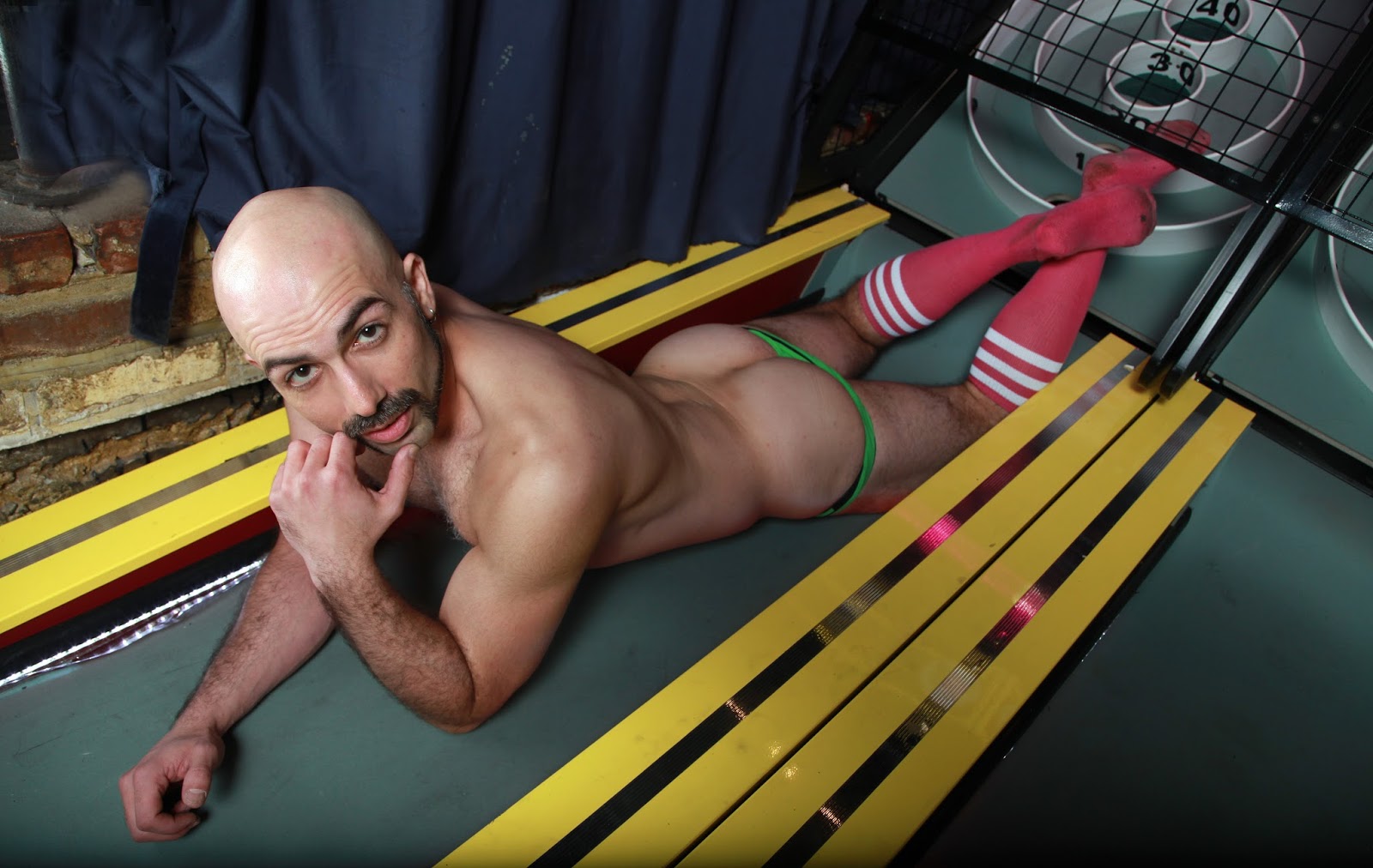
Alberto Denis...or should we say GoGo Gadget?
(photo by Mike Dennis)


Alberto Denis: On becoming GoGo Gadget

interviewed by Eva Yaa Asantewaa
About two or more years ago, I thought I was all but done dancing for anyone but myself...I'd considered that perhaps the dance world, for the most part, was done with me. – Alberto Denis
Ah, but all that was before GoGo Gadget!

On the second annniversary of GoGo Gadget’s boylesk debut, dancer Alberto Denis–now starring in Third Rail Projects’ acclaimed Then She Fell--recalls his liberating transformation into this sexy-nerdy character.

Alberto Denis
(photo by Gustavo Monroy)

Yaa Asantewaa: When you arrived at the idea that you were done with dance--or, perhaps, it was done with you--you eventually turned to burlesque.  What drew you to the burlesque movement?

Denis: Over the years, I rarely engaged in solo choreography and was pleased to learn that I might in fact have something to say. That my work was well received enough to warrant frequent remounting of the work was a surprise to me. XXXV spoke to my experience of time and moments in my life, my journey from infancy to the age I was then--35. While it was fleetingly rewarding to create work on my own, it wasn't what I'd envisioned for my dance career. I was left questioning what, if anything, lay ahead of me.

My struggles with body image are, somewhat unfortunately, inexorably linked to a very natural desire to build a loving, passionate relationship. I'd spent the past several years as a bachelor and continued to find that, in searching for a partner, I focused more and more on my body image. I believe this to be primarily driven by societal norms as well as behaviors within the various communities to which I belong--my identity as a gay male and as a self-proclaimed geek.

I wanted to make a new work, which I'm finally embarking upon now. I wanted to explore my struggle with body image and the concept of attraction. At the time, doing research on bulimia and anorexia, while valuable, was a bit too depressing. I decided to take a look at the resurgent burlesque community and do positive research on a field that celebrates the female form regardless of societal norms.

I went to a performance called Meaner, Harder, Leather which introduced me to the concept that men also participate in burlesque, in what is casually called boylesk. Over several months, I continued to attend performances and befriended a very prominent performer--Chris "Go-Go" Harder–and attended his five-weekend burlesque course.

In that setting, I fully let down my guard, embarking on the long journey of accepting and occasionally celebrating my sexually attractive body. Even thinking those words is still difficult; I'd like to believe that I'm attractive to at least a few. But GoGo Gadget, unlike Alberto, is overly confident, assured, sexual and provocative. I'm so grateful for him, as I truly believe he's directly responsible for my personal growth as a dancer/actor, and he contributes to my process with Third Rail Projects.

GoGo Gadget in action
(photo by Gustavo Monroy)

Yaa Asantewaa: Where did you see Meaner, Harder, Leather? How extensive is the male participation in the contemporary burlesque movement relative to female dancers?

Denis: Meaner, Harder, Leather ran for what I believe to be a little over a year at what was then the Vig 27 Lounge on 27th Street between Park and Lexington. In the few years I've been exposed to the burlesque community, I've seen the ratio of male-to-female participants spike significantly, in no short part due to Chris’s workshops. When I began there were perhaps half a dozen or so regularly performing men, whereas now--just from the performances I've been able to see--I've seen closer to twenty-five to thirty male performers engaging in boylesk on a regular basis.

Yaa Asantewaa: What helped you to let down your guard?  Let us in, a little, on the process of how you grew in self-acceptance.

Denis: I felt comfortable participating with a group as opposed to working as an individual, and also with Chris' very enthusiastic and well thought out process for leading the workshop. I'm still growing toward acceptance of what is physically attractive about me. It has been rewarding to rediscover my dancing ability within the context of a different community. To see it rewarded and celebrated has sparked a sense of "attractiveness" that I don't necessarily experience within the context of my dance community.

I believe that courage is also attractive, and I've had to learn to build my courage each time I build a new boylesk act and try it out, both to see if it works and the more basic fact that, by its conclusion, I become fully, physically exposed.

Also, for two years running, I've had an incredible collaborator in my gym trainer, Ray La Roca Grijalvo of SEEK FITNESS, who is genuinely invested in my success and achieving my physical goals. He and his wife have attended several of Gadget's performances. He's also developing relationships with many of my neighbors who also struggle with body image challenges.

Yaa Asantewaa: What’s behind the name GoGo Gadget?  How did this character develop?

Denis: GoGo Gadget references my own Peter Pan complex, directly linking the name to a cartoon from my childhood. Inspector Gadget, a cartoon character of the 1980s-90s, was very popular in my youth. He was often put in situations where he was ill-prepared to succeed, and yet he always prevailed. Gadget also references my love of all sorts of tech gadgetry. (I’ve been employed by a major technology company for the past several years.) Gadget's development is still very much in progress and grows with each performance and each new work.

Yaa Asantewaa: How do you go about bringing him out when it’s time for him to perform?

Denis: The best way to bring him out is through masks, makeup, costumes, music and glitter.  Lots and lots of glitter!  Oh and bubbles too!  Gadget loves candy, fun, sweating, dancing, cartoons, comic books, adventure heroes, men, and a few women too.  And most importantly, he absolutely loves getting naked and feels beautiful about his appearance.

Yaa Asantewaa: Does his personality influence you and help you in everyday life? Or is this something segregated to dance or, specifically, boylesk?

Denis: What a fantastic question! I continue to struggle to introduce his ever-forming personality within my everyday life. I can say that he continues to grow in boylesk, and now recently is certainly making his presence known within my dance identity.

Yaa Asantewaa: How does GoGo Gadget influence you as you prepare to perform in other dance work, including your work with the celebrated immersive theater troupe, Third Rail Projects?

Denis: I can say that Gadget has directly influenced my ability to take greater risks when developing another role. That courage I spoke of earlier is accessible to me outside of burlesque. My latest role creation draws a great deal from my nightlife experiences as Gadget, asking me to be sexually enticing to both men and women, an outrageous attention whore, physically provocative, as well as physically innovative. Gadget's regular activities on stage often explore these kinds of themes, and I'm drawing heavily on my experiences to create dance scores for my new role based on this kind of material.

Yaa Asantewaa: Would you recommend some training in boylesk to other male dancers? If so, why? What could they take away from it?

Denis: I believe if a male dancer wants to challenge both his perceptions of self- identity on stage as well as develop his choreographic skills, boylesk is an absolute must. It's a brilliant combination of dance and theater structured in a way that requires taking emotional as well as physical risks.

If you happen to be in Paris on October 5, you can see GoGo Gadget in action at The Lettingo Cabaret. New Yorkers, keep watch for news on the GoGo Gadget front for late fall.

Alberto Denis
(photo by Gustavo Monroy)
BIO

Currently a member of Third Rail Projects and featured in their production of Then She Fell, in 2008 Alberto Denis created [QuA²D] = The Queens Academy of Arts & Dance after leaving his position as Production Director/Producer for Dance New Amsterdam where he created the first ever staff infrastructure for their inaugural theater on Chambers Street in lower Manhattan, while co-curating their first three seasons of programming. Previously he created the Wight Room Dance Series presented at The Movement Salon near Union Square. Alberto Denis has toured the world (Dubai, Dublin, Barcelona, Bangkok, Taipei, Mexico City, Oslo and Prague and more) as a stage manager, audio engineer, assistant technical director and production electrician as well as a performer for many choreographers. He has performed for Arthur Aviles' Typical Theater for five years and in projects for Doug Elkins, Risa Jaroslow, Palissimo Dance Theater, Dixie Fun Dance Theater, ann and alexx make dances, Marta Renzi, Alexandra Beller, Michael Leleux, Heidi Latsky Dance, Lawrence Goldhuber, Luis Lara Malvacias, JoAnna Mendl Shaw’s Equus Projects and Mei Yin Ng’s Mei-Be Whatever. He was also a featured performer in the Whitney Museum's Christian Marclay: Festival performance of Prêt-a'-Porter. His choreography has been produced at Dance Theater Workshop's Family Matters, Danspace Project’s Food For Thought, Dixon Place’s Body Blend and Moving Men, BAAD!’s Boogie Down Dance Series and Out Like That Festival and Kinetics Dance Theater, Baltimore MD. He has also served on the Dance Theater Workshop Curatorial Advisory Committee.